Graduation!!!

It’s been about 6 years since my first acupuncture treatment, which in the scheme of things, isn’t actually all that long. I got acupuncture at first for Bell’s Palsy, paralysis of the half of my face, a purely aesthetic issue, but we all like to put our best face forward and so it felt important. Acupuncture changed my life – it actually brought me closer to myself, it helped me strengthen my connection to who I am and my life’s purpose and, well, landed me here today. Ironically, I never resolved the original symptoms and I stand here today with a somewhat asymmetrical smile.

Every one of us has a story about how we arrived here. Some of us came to Chinese Medicine through martial arts, I know that many of us were disappointed in some way or another by Western medicine, maybe we saw our sister get pregnant and have a child with the help of acupuncture, or a parent get relief from back pain, or a sibling recover from a car accident – we all recognized that this is some special medicine, and we all knew that we wanted to help others, to play a supportive role in people’s journey back to health.

And some of chose SWAC because we were already living in Boulder, or because we toured across  the country looking at all the schools and liked it the most, or because we knew someone who went here. I transferred from New York when the city became to much, we’ve got transfers from Florida, and Denver, and Albuquerque and Hawaii . I remember walking in on the first day of class, and thinking to myself, “Oh, everybody already knows each other, I’m the awkward new kid” (I’m still awkard I’m just not new anymore) but then Koji came over and welcomed me in, and slowly but surely the collection of awesome people that make up our class befriended and welcomed me, just as the would any other person, because that’s who we are, and that’s how we roll.

And I sat through my first class with Michael Young, blown away by his insights on dysbiosis and leaky gut, and so my education continued. Tristan would diligently go over each any every acupuncture point, and give us meticulous tests (which I was grateful for when it was time to talk the board exams), and Jia Yu would pound into our brains “don’t treat the symptom! Treat the etiology!” And we poked each other in class and we poked patients in the clinic, and most people got better, but some didn’t, and we learned a LOT. I mean come, on, over 350 points, and over 30 herbs a few hundred herbal formulas,  pattern differentiation, 3600 hours of study… lets give ourselves a little round of applause here.

And now, we move on to the unknown.

First, we must take a pause. To rest, to recollect, to replenish and reflect.

And then no do doubt, we will stand up tall, connect to our will power, acknowledge our fears, recognize the wisdom we’ve gained, and move forward. With guile and gall we’ll muster the courage to start a practice, to treat our first patient with a supervisor, and then the second, and the third. And it’s gonna feel awesome!

And there’s a couple of things I hope we can all remember as we head out on our own.

This Medicine is Incredible! It’s so powerful and so diverse in application, and we happen to be in the midst of a changing of conscious which is going to create endless possibilities. We live in a time when our medicine can be Magic AND Science, not either or. Our medicine can speak so many languages, and WE can speak many languages. We can talk in Biomed about hormonal pathways and neurons firing, and we can talk the words of Shaman penetrating through matter and into the world of spiritual vibrations. We can talk about IBS or “leaky gut syndome” or SP Qi Xu or hungry ghosts. We can say that an herb is a diaphoretic or that it releases the exterior – and that’s good, because it’s both! We can hold one perspective in each hand and work with each patient accordingly.

We’ll be able to get rid of a patients back pain so she can go back to teaching at school and treat the children with more kindness and compassion because she’s not constantly taxed by her pain – but maybe we’ll never talk to her about fear or spirit.

And maybe another patient will still have trouble sleeping through the night, but he’s living a brighter and happier and more grounded life than ever before, because for the first time in a long time, he’s had the opportunity to open up a bit and share and discover and process some of his emotional blockages.

We are the makers of our medicine, engaging in an ancient tradition, with our own new modern flare, dancing whichever dance our patients need – sometimes it’s the samba, and sometimes its the waltz – but it’s always a dance towards health and wholeness.

This medicine is also mysterious. We’ve been studying in for four years and only barely brushed the surface. And some patients, respond immediately and dramatically and boom! they’re better. And some patients don’t see any change at all, for weeks, and eventually stop trying – and we don’t always know why. But it’s not just this medicine that’s mysterious, it’s healing, and it’s life – sometimes, we just have to learn how to sit with the mystery.

This medicine came from people who watched nature and the earth – and we still have lots to learn from the natural world. For instance, our recent understandings of ecosystems teach us that diversity is the key to resilience. If we look at the world around us, we will notice (if we pay attention), that there are many many different plants and animals living together in any given environment. They all have different roles to play, different functions in keeping the balance of resources flowing and growing within a system.

I like to go hiking in the mountains, and every time I go I’m blown away about how many songbirds, singing different songs and different insects, pollinating different flowers And it’s important that we don’t forget how similar to the songbirds and the insects we are – and what I’m trying to get at, is that as we all step out into the world we should remember to feel free to be ourselves, different from others, filling a unique niche that will be bring it’s own balance to the ecosystem of humanity.

Some of us may be like honeybees, buzzing around with a communal mentality, “pollinating” many flowers of all shapes and sizes, producing a great sweetness in our community. Others may may, like a particular moth only work with a particular orchid as their one-and-only specialty, which will also bring great beauty to world as well. Without honeybees the world would not be complete, and without moths and orchids the world not be complete and without each and everyone of us the world is not complete. 

Friends, or should I now say Colleagues, how about Fellow Acupuncturists!

I think I speak for all of us when I express a great gratitude to be living on this great planet full of an abundance of life, to be living in an era with an incredible abundance of information, to have an abundance access to the resources to acquire a unique and very powerful set of tools that will allow us to transform individual lives and entire communities for the better.

And I really have to say thank you to our teacher, staff, and all those that paved the way for us.

We all dedicated our lives for the past few years to developing a strong foundation to be pivotal members of our communities. Our hard-work and devotion in school and the fact that were all here together today are proof of our ability to persevere and achieve what we have committed to.

Now lets get out there and heal the world!
Mid-semester reflections

I’m just more than half-way through my first semester here at SWAC (http://www.acupuncturecollege.edu/), and so far things are going well. It turns out that as part of the transfer process I ended up in a few classes that are for the most part review. Initially I was some what frustrated and bored, but at a certain point I started to put more into the so called review to make the most of it. It turns out I learned a whole lot of new things and now have a much more nuanced understanding of things I thought I already knew. Why this surprises me, I don’t know.

These mid-terms happen to be falling right after a  yearly fun-filled Jewish Holiday called Simchat Torah. It’s a celebration of the fact that we finished reading the whole entire Torah (Pentateuch) and get to start it all over. Why would be excited to start rereading the same book over again from the beginning? Why would be excited to re-celebrate the same Holidays over again? Well, there’s something nice to the familiarity, but I don’t think that’s what it’s about. It’s about a deepening of our relationships and understanding. The idea is that maybe there’s something new to learn, even where we thought we already knew everything. Maybe we missed something the first time around. It fosters an attitude towards life and towards learning that implies a certain amount of humility, an awareness that though we may have come far, there’s plenty more to go, and it requires us to cultivate curiosity and interest, even in the seemingly familiar.

Wait a second, what did I miss the first time around? What didn’t I notice? What don’t I remember? How does where I am right now and the knowledge I already have change and contribute to relearning things a second time around?

For me this all stands out the most in the arena of the Acupuncture points – who are they? where are they? and what do they do? By now, I’ve learned them all once through, I’ve been tested on all of them once through, why again? Well, it turns out that there are more than handful that I didn’t really know all that much about. There were a few that I could locate, but wasn’t all the comfortable needling them, and there were some that were just shrouded in mystery (plenty of them still are). But after relearning a handful (and we’ll be reviewing another handful the rest of the semester), I have a much better understanding of all of them and a deeper appreciation for what they do and when to include them in a treatment.

Just as important as a deeper understanding of the material, I experienced a valuable attitudinal shift with regards to my learning process. Instead of resisting “relearning things I already know,” I can eagerly approach familiar material to get deeper into it and expand my relationship with it. If I see the “information” as static, than my relationship with it is static, but if I hold onto an awareness that this medical material is a dynamic body of living knowledge, my relationship with becomes alive. A living relationship still involves ups and downs, frustrations and confusions, but it also creates space for more enrichment and growth.

Whether you’re a cook or an engineer, a manager or a lawyer, an artist or a mechanic, you can consider your attitude about your learning process and where you’re at, and examine your relationship with body of knowledge that’s out there and how it may contribute to your practice. The fall, is a wonderful time for refinement and enrichment!

Beginning of a New Semester

Things feel different this semester. I’ve discussed it with a couple friends and they agree. We seem to have passed a threshold, out of the foundation building level, and into the level of application and use. This semester we’re finally getting into the details of diagnosis and treatment of diseases (we’ll be focusing on respiratory and digestive disorders), advanced needling techniques, and herbal formulas (as opposed to focusing on the individual herbs). I’m also taking an elective class on the “Huang Di Nei Jing” or the “Yellow Emperor’s Classic” which essentially the “bible” of Chinese Medicine (I’m hoping for some interesting posts to come out of that class).

This is also my last semester in New York. I’m taking the summer off and will be moving to Boulder with my now fiance then wife! I’m looking forward to being in an environment and culture that is more outdoor and nature oriented. I’m curious to see how that affects the types of pathologies that come into the clinic and I’m eager to see how a different school approaches teaching and learning Chinese Medicine. That said, moving can be a very stressful life event. It involves saying goodbye to people, a place, and things, and it requires a certain amount of courage and willingness to face the unknown. The hope is that it will be an experience that fosters growth and also allows us to more easily live a lifestyle that is in line with our values.

Speaking of value, this past week I’ve caught myself in the mindset of “making the most” of everything: of my last semester, of my last months in New York City, of the time I have with my friends. I think it’s an attitude quite prevalent in our society, especially in areas like New York, and while in many ways it can serve positive purposes, it can also be a hindrance. It’s easy to get so caught up in trying to “make the most” or “find or be the best” that it’s hard to make any decisions or to enjoy what is. And when making the most of my semester at school means taking some of the more demanding classes, but making the most of my last months in New York means taking less classes so I have more time to explore and frolic, I found myself in a bit of a pickle. So, here’s too just what is, and to remembering that “making the most” is not necessarily as much about content as it is about how we approach life.

Finally, I’d like to write a blog-post on “How to find the right Acupuncturist for you” (this comes after being asked a number of times by people for recommendations and/or advice on the topic), and I think that a fair share of people out there reading might have some good advice/stories on the topic…. so if you do… please either comment here or e-mail me.

Happy New Year!

Advice to an Interested Undergraduate

It looks like it’s the season to be turning e-mails into blog-posts… I’ve been pretty busy just coming out of mid-terms and starting to focus on studying for our Comprehensive Exams that come at the end of this semester and cover all the material we’ve learned up until now. I just got an e-mail from a friend asking a few questions about “alternative medicine schooling.” I figured it might be something a wider audience would be interested in… so, for all those potential students of Chinese medicine out there…

I like these questions, they’re very practical, and they’re important things to have information about.

a) Recommendations for what to study undergrad to prepare for such graduate work. Would community college be a reasonable direction to take?

As far as undergrad goes, I would say that you can probably study whatever you want to, but it would be very very helpful in terms of both saving time and money to take as many bio-science classes as possible (similar to a pre-med major – but the way that usually works, is that you can often major in anything: English, Philosophy, History, while taking pre-med classes). These classes will be accepted as your Bioscience classes for your school and you’ll have a firm foundation and understanding of the sciences. That said taking some electives somewhere along the line about Eastern thought/philosophy, Confucianism, Daoism, or Chinese History could also be helpful is setting up an understanding of where the Eastern medicines come from philosophically and culturally.
Another really important thing: not all schools require a full-undergraduate degree. So my current school (PCOM) for instance only requires I think around 60 undergraduate credits, and graduates then receive a Bachelors and a Masters when the graduate. Other schools like the one I’m transferring too (Southwest), do require Bachelors. I think community college would be a great way to go for undergraduate. You’ll save money and most likely get a good enough education to have the foundation you need for grad school.

b) Thoughts about what a person who’s interested in the field should do to prepare themselves
Self-cultivation. I would strongly recommend focusing a substantial amount of energy on figuring out who you want to be (as opposed to only thinking about what you want to do). You can practice being who you want to be every day, no matter what, and doing what you want to do should be an outgrowth of that.
Having a “spiritual” practice is important (meditation, prayer, yoga, qi gong), as is learning/knowing how to take care of your physical self (getting enough sleep, eating well). Spend the time leading up to school learning how to cook, learning what type of exercise is most enjoyable/fun for you.
Personally, I’d also recommend spending some time in some form of psychotherapy. This may sound a bit strange, but the more whole you are as a person, the more you’ve done to mature and understand your self, the better you’ll be at helping others and understanding others. I spent around 8 months in therapy my senior year of college and learned a tremendous amount about myself, patterns that I may have, weaknesses, strengths, etc. Getting to know yourself is important.
Touch people! Not in inappropriate ways (haha), but seriously, the more experience you have getting to know other people’s bodies with your hands, the better off you’ll be. To me this mostly means giving massages to your friends and family, being comfortable sharing your touch with them will help become comfortable eventually sharing touch with people who are initially complete strangers.
Read “The Web That Has No Weaver” and flip through some anatomy books.
Be treated by whatever modality you’re interested in. If it’s acupuncture, go get some acupuncture, from one person, from several. Get a massage or two or three. Talk to a few practitioners, find out what they like about it, what they don’t.

c) Thoughts about what the awesome things and the harder things are about going to alterna-medicine school
This questions is pretty fascinating to me, because a lot of the awesome things about school are the harder things about school. The awesome things about going to complimentary medicine schools are that you’re learning to help people heal. You’ll become part of a community of people who are working to help alleviate suffering. You’ll come to understand yourself, other people, and the world in new ways. Assisting others on their path to health is a fairly large responsibility, you have to know and understand a lot about how the human body works, from a Western scientific perspective as well as from an East Asian perspective. A lot of the concepts of the medicine may be foreign, some of them may not really make much sense at first, but eventually you’ll get it.
Also, I think it’s important at some point to do some research on the job market, and understand how much money you can expect to make and what it might take to either find a job or start your practice.

I’m always open to fielding more questions… and interested in hearing other people’s thoughts…

Stay warm, and don’t forget your Vitamin D!

Needling: Acupuncture Techniques

Part of the acupuncture curriculum involves, over the course of our 3-4 years of study, needling all of the points AND having most (if not all), of the acupuncture points needled on us. How many surgeons can say they’ve had the surgeries they’re performing performed on them or how many psychiatrists know what it feels like to be on the pharmaceuticals they’re prescribing  (yes, I know that’s different, but it’s worth a thought nonetheless)? This is a way for us to know know what our future patients are experiencing, and we serve as practice dummies for each other.

Today in class amongst the points we needled were L.I. 15 Jianyu and S.J. 14 Jianliao. These two points are at the origin of the deltoid (shoulder muscle) and needled into the shoulder. We have a great teacher who does a really good job demonstrating and guiding us through the process, and what was amazing, where the affects of needling the point. The shoulder completely relaxes is opened up. My needling partner gained around 30 degrees of range-of-motion with about ten minutes of needle retention. I have pretty flexible arms as is, but really felt my shoulder joint relax and open up. This has me looking forward to learning about needling more of the areas where I (and/or my loved ones) tend to hold a lot of tension.

It’s amazing what the body will do when poked in the right direction…

On Being Challenged

I just took the most challenging test I’ve taken at PCOM so far and I’m actually really grateful for it. To be perfectly honest, so far, school hasn’t been all that challenging. It hasn’t been a walk in the park and there have been plenty of stressful moments, but it also hasn’t pushed me to my limits. I like being pushed to my limits – because that’s when I learn how to break through them. I like being asked questions that make me think and apply my knowledge,and not just regurgitate information that I’ve memorized, this was a test that asked me to think.

This was a test that really engages you with the material, giving us mini-case-studies and asking us which herb(s) we would use, asking us to recall commonalities between herbs, differences between herbs, when should one be used over the other. It was a great test, the kind of test I’ve been waiting for since I came back to school, and guess, what… I don’t think I did all that well. I think I did okay, and that’s okay because I’m learning and the grades are here to guide me, to help me understand how I’m doing and if there’s anything I need to be doing differently. Now I know there is.

Here’s to being challenged, and being in a place where we respect the challenges and appreciate them as ways to grow.

Acupuncture and Herbs…

or Herbs and Acupuncture?

Acupuncture and Herbs are two different Chinese healing modalities. They are based in the same fundamental theory and grow out of the same foundational ideas, but they were not necessarily always practiced by the same people, and require a different set of skills and knowledge. They can both heal a number of conditions, but in different ways.

I personally was attracted to Chinese medicine because of acupuncture and my personal experiences with it. I am a very hands-on person and love massage and touch. Initially, I was planning on going to a school that teaches only acupuncture because of a philosophical belief that one should master one medicine before learning a second. But, for better or worse (I think better) that is no longer the case. I still have the option of learning them sequentially, but I’ve been hearing from the school’s faculty and from some senior students to go ahead and learn it all at once. While I’ve heard plenty of practitioners who use only acupuncture say they don’t need herbs, I’ve also heard practitioners say they can’t imagine treatment without herbs (I’ve even had one student tell me that her perception is that those that learn acupuncture without herbs are not as good at acupuncture).

Now, I also tend to be the kind of person who wants to do it all at once, and while I was attracted to Chinese medicine because of acupuncture and the physical touch elements involved, I was coming from a background of ecology. My love of nature and of the plant and animal world is deep, and any opportunity to learn more and connect in new ways to the natural world is one I’m eager to pursue. This semester I’m taking my first herbs course (required for all students regardless of whether or not they’ll be studying herbs further down the road), and I’ve fallen in love. I am super excited about learning more, and about getting to know as many of the herbs as possible on a personal level by growing them (if anyone knows of seed suppliers please inform me, I have a few leads on some sources in North Carolina and upstate New York and will happily share more information as soon as it’s confirmed). I’ve also experienced first-hand the healing power of some of the herbal formulas (specifically a formula called Shao Yao San) and want to be able to share that with patients.

Which leads me to the next point of contemplation: will I end up using herbs therapeutically? While they are powerful healers, patient compliance is not always the highest (they’re often inconvenient to take, or taste bad), and they add an expense to any treatment (which isn’t an option for all patients), and depending on where I end up living and practicing, they might not be easily accessible.

Doing herbs with the Acupuncture program means 2 more semester, a fair amount more debt (which I plan on discussing in a future post), and most importantly a potential that I’ll be missing a little from both (the human brain can only absorb so much information at a time, right?). One thing I’ve noticed so far is that I’m spending a lot more time studying herbs than I am studying my acupuncture points. Part of that has to do with how my memory works, and I just happen to be able to get points right away, but I wonder what things will look like down the road.

There’s another little conundrum hiding it’s face amongst all these contemplations regarding my ability to take classes in the Classical Chinese Medicine while doing the full Traditional Chinese Medicine program, but I won’t go into that right now.

So there’s one of the many many things that’s been on my mind regarding my studies, As always, I’m open to hearing people’s thoughts, opinions, and ideas.

Shine on, and drink some dandelion tea to help heal the world (more on this soon enough).

Memorizing

A huge part of being in medical school (Chinese or Western) is memorization. It’s unavoidable. Every week, tons of information is thrown at us, and we are responsible to absorb and assimilate it, and to have rapid recall. Fortunately, our brains are powerful, and only get stronger with exercise. For better or worse, memorization requires repetition and focus, however, it probably takes less concentrated time than we expect.

Okay, everyone’s mind works differently, so I guess I can’t speak for everyone, but I can speak from my own experience, and from what I’ve learned from others (like Cal Newport). I find that generally speaking, sitting down for a four hour study session, is far less effective than running through my notes 2 or 3 times over the course of the day and reviewing them. This is especially effective in the morning, and right before you go to bed.

It also really really helpful to have a good understanding of how your brain works and what type of learner you are. Many of us are visual learners, some of us are audio learners or kinesthetic learners. I find that movement and speaking out loud is really helpful for me. I don’t really feel comfortable with the material until I’m able to explain it to someone else (this is slightly problematic with boring material that’s less relevant to people who aren’t studying Chinese Medicine). If I can speak it out to someone, I know I know it.

And don’t forget about acronyms…

More about memorizing and study techniques later (now I have to get back to studying, hehe).

I’d love to hear about tactics you apply…

Life, School, Stress, and Feeling Good

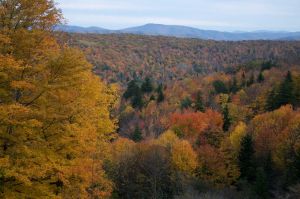
Fall Colors of the Alleghany Mountains of Virginia

Fall Colors of the Alleghany Mountains of Virginia

As the Fall begins to sink its fingers into the Northeast with cooler weather, shorter days, and some crazy wind we’re moving into more complicated material and through an intense midterm period. I managed to get out the city a couple of weekends ago, which was incredibly important for my health (though by now some of the therapeutic effects unfortunately seem to be waning). My girlfriend and I drove down to the Allegheny Mountains of Virginia. We were lucky to have perfect timing and were there for peak colors (the trees turn earlier in the mountains, despite the latitude) and even saw a Bald Eagle!

Now, I find myself working harder than I’ve had to in a while, as my two part-time jobs are demanding much more from me. I have two part-time jobs because I want to make it through school with minimal debt and because I want to continue to cultivate myself beyond the boundaries of Chinese Medicine. I’m working as an environmental educator for an organization called The Wild Lab. It’s an awesome organization and our program is super-cool. Essentially, we’re using an iPhone application to teach students about birds and about citizen science. My other part-time job, which is currently only a couple of weekends a month, involves care for adults with mental disabilities. I’m currently skipping my daytime classes to attend a course that will certify me to administer medications (I’ve still managed to make it to my evening classes, both of which involved quizes this week), the course is a New York State specific thing.

All that said, I did want to hop online, write a little update, remind myself and the world about the realities of being a student, and share briefly an experience that has me thinking more about health and what it does and/or doesn’t mean, and how we regulate our health.

Last night, I was feeling very stressed out, a bit overwhelmed by the number of things on my plate (tasty as those things may be). I was tired, and having trouble finding the energy,desire, or focus, to do anything, but zone out (something I clearly needed to do). To create more context I had gotten very little sleep the previous night, and eaten crappy food that day. Today, I’ve been feeling much better, and in fact came home excited to work on flashcards and memorizing all of these medications and what they’re prescribed for, because learning is awesome (of course I had to write first). Last night I got to bed at a decent time, and today, I think I ate stuff that my system was more happy with.

Nothing external really changed all that much. I still have 3 midterms on Monday, and my first day teaching in the classroom on Tuesday, and I’m still working part of this weekend. But I’m feeling better, and therefore more able to cope with the challenges I face. Now, we all have ups and downs, that’s natural. We have to balance the energized Yang periods of our days and weeks with restorative restful Yin periods of time. But I’m wondering about how we feel within those moments, and who or what’s in control of when and where they occur. I don’t have answers, and I think the answers are different for everyone, but the only way to find the answers is to be aware and observe ourselves and pay attention to what’s affecting us and how.

For the record, personally, I’m examining specifically which foods do what to my body and state of mind, and have been learning a lot about nutrition from a Chinese medical point of view, and hope, at some point, to have a series of food and nutrition related posts (hehe, though I’m sure we’re all sick of different people telling us what and how to eat – which is a whole other topic I plan on exploring).

So, let’s all try to pay attention to what makes us feel good, and what makes us feel not so good… and let’s try to do more things that make us feel Good 🙂

And now… off to the books.

Questions? Comments? Thoughts?

Why I chose PCOM (or How PCOM chose me)?

Once I decided I wanted to start my journey to become a Chinese Medicine practitioner, I had to figure out which school to go to. Fortunately, I had experience picking out schools from my undergrad years, and I’d say the first step this time around was to talk to people.

What became apparent was that there are a few different styles of acupuncture and some school focused on a specific style,  so it was important to know which style resonated with me.  Location would also be a key factor, as would the scheduling (many schools offer classes on the weekends and/or evenings to allow people to work part/full-time) and of course the overall vibe of the school.

I immediately narrowed my search down to the Northeast, specifically Boston and New York City (I did look at some other schools around the Northeast) mainly because I didn’t feel like it made any sense for me to uproot myself and go somewhere I had no established connections, I’ve done enough of that in my life, at some point I might be ready for it again, but not yet.

Boston has one really great school, NYC had three. I slowly realized that I wasn’t really going to leave Brooklyn so soon (I’m part of a very supportive and nourishing community here) so I had three options: Pacific College of Oriental Medicine (PCOM), Tri-state, and the Swedish Institute.

PCOM  is the largest of the three, which potentially means that they have the most resources. It’s also the most expensive. It offers the most schedule flexibility. PCOM was also a strictly TCM school, with a strong emphasis on herbs. My initial vibes from the open house weren’t all that positive. I felt like it was a good school, that would teach me acupuncture, but that maybe it lacked some umph, some spirit. It felt very matter-of-fact.

Tri-State totally wowed me at their open house, though I was already somewhat more inclined towards Tri-state. They offer a unique 3-tier curriculum where you learn TCM, Japanese style acupuncture, and a European French Meridian System/American style. The idea being that more styles equals more tools and different patients will respond better to different types of treatments. Alumni I spoke with were very happy with their education there. Tri-state also offers a very hands on curriculum with palpating from day one and needling within the first trimester. Their schedule is set, and is pretty solid. Classes are mostly on the weekends, with a couple core classes on Monday and Wednesday(?) evenings. I left the open house feeling unsure whether I was wowed by quality or by charisma, and unsure about having so much class time on the weekends

Then there was the Swedish Institute. It seemed somewhat hard to get a hold of anyone and hard to get answers. Their focus was clearly on massage. Their acupuncture was unique because it had a Classical focus. The Dean, Jeffrey Yuen, is a well known leader in the field of Classical Chinese medicine and as an ordained Daoist priest in the 88th generation of the Jade Purity School he brings a lot to the table. I had heard a lot about him, and felt very drawn to the Classical approach. It sounded like I would be go deeper into the medicine. He spoke at the open house, and while he was speaking I just felt in my gut that I needed to go there. It was a surprising experience because I generally think of someone who makes decisions very intellectually, based upon methodical thinking and analysis, but here I was feeling a very strong gut feeling of “this is where I need to be.”

To make an already long story short, Jeffrey Yuen has moved to PCOM. So, I moved to PCOM, which now offers 3 programs: a 4-year Masters in Oriental Medicine (MSTOM), a 3-year Classical Chinese Medicine (CCM) program, and a different 3-year acupuncture program I don’t quite understand much about. I’m planning to go down the CCM path, which doesn’t include the herbs (the Classical approach is that you should first develop your skills as an acupuncturist and later learn herbs which originally evolved as separate medicines). I do plan on learning herbs shortly after I’m done with the program because I understand that they’re very powerful. Fortunately, we don’t have to make any final decisions until after our second semester, after we all take Herbs 1, but I’m pretty comfortable and confident with my decision. Interestingly enough, I feel like PCOM strongly stresses MSTOM program, largely because it’s the only program that certifies you to practice in California which has its own higher level of requirements for licensure. It’s like they expect us all to want to move to California at some point for some reason.

So that’s how and why I’m at PCOM. I’m happy there so far, and I think that bringing the CCM program to PCOM will be beneficial to everyone and so far am happy with my experiences there.

Let me know if you have any questions, comments, or want to share about your decision to be at whichever you’re school at!